
Wooden Balance Stacking Blocks: Why Montessori Moms Love Them
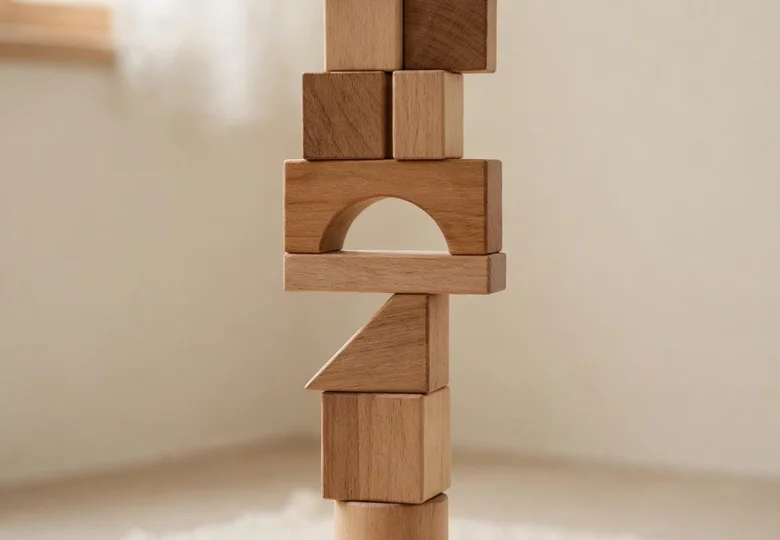
Of all the toys on a Montessori shelf, the humble balance block might be the most loved. It is just a set of smooth wooden pieces in different shapes and sizes, no lights, no sounds, no batteries, nothing to figure out. And yet toddlers return to it day after day, building towers, knocking them down, and starting all over again.
There is a reason this simple toy has stayed on nursery shelves for generations. It grows with your child in a way few toys do: a one-year-old stacks two blocks, a two-year-old builds a tower, and a three-year-old builds a whole city. The toy never changes, your child does.
Quick Picks from This Guide
What Balance Blocks Actually Are
Balance blocks are wooden pieces cut in different shapes, rectangles, triangles, arches, cylinders, sized so a toddler can grip them with one hand. Unlike uniform building bricks, each piece has its own weight and balance point, so stacking them is a real challenge. A tower built from balance blocks wobbles, leans and sometimes falls, and that is exactly the point.
The pieces are usually made from smooth natural wood with a clear finish, so you can see the grain and feel the warmth of the material. There are no bright plastic colors and no printed characters, just wood, in soft natural tones that look at home on a nursery shelf.
Why Montessori Moms Reach for Them First
Montessori play is built on the idea that children learn by doing, and balance blocks are doing in its purest form. Every stack is a small experiment: will this piece balance on that one? What happens if I put the big piece on top? Your toddler is testing ideas with her hands, and every wobble is feedback she can understand.
The toy also respects a child's pace. There is no timer, no score and no voice saying "try again." A toddler can stack two blocks and feel proud, or spend twenty minutes on a tower that keeps falling.
From First Stacks to Imaginary Worlds
The first thing a baby does with a block is chew it, and that is fine, smooth wood and rounded edges are made for exactly that. Then comes banging two blocks together, then stacking two, then three. By eighteen months, towers appear. By two, those towers get names: a house, a bridge, a castle.
This is where balance blocks outlast most toys. A three-year-old does not just stack them, she builds roads for her wooden animals, walls for a doll's house, and bridges for a toy car to drive under. One set of blocks becomes a dozen different toys, depending on the day.
What to Look For When You Choose a Set
Not all block sets are equal, so a few details matter. Look for smooth, sanded wood with rounded edges and a clear finish. The set should include a good mix of shapes and sizes, not just identical cubes, because variety is what makes balancing interesting.
Check the age guidance on the listing and choose pieces that are big enough for your child's age, with no small parts that could come loose. A set of twenty to thirty pieces is plenty for a toddler; more than that mostly means more pieces to tidy up.
Keeping the Play Going (and the Pieces Together)
Blocks scatter, it is a law of nature. A small basket or a cloth bag by the play shelf keeps the set together and makes cleanup a game in itself. Many moms find that a "put the blocks to bed" routine works surprisingly well when the basket is low enough for a toddler to reach.
Rotate the blocks with other toys every couple of weeks to keep them feeling fresh. Pair them with a shape sorter one week and a rainbow stacker the next, and watch how the play changes. And when a tower falls for the tenth time, resist the urge to fix it, the falling is the lesson, and the rebuilding is the joy.
For more wooden toy ideas and quiet play inspiration, follow our Montessori Toys & Wooden Toys board on Pinterest: Montessori Toys & Wooden Toys board